Author: Josh

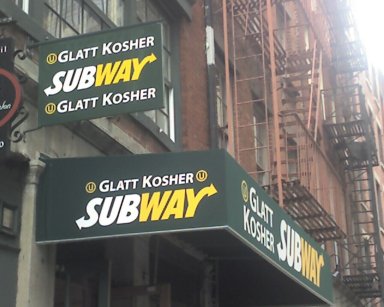
Downtown Kosher Subway Review

UPDATE: It has come to my attention that the kosher Subway reviewed in this post is no longer. Read on for what was and could be, but making a special trip would be unwarranted.
Those of you up on the latest in Kosher food scene probably heard about the new kosher Subway in the financial district on 28 Water Street. While this is not the first kosher Subway – there are locations in Brooklyn, Queens, and Livingston NJ – this one just happens to be conviniently across the street from my office. Like many Jews in the area, I thought I’d give it a shot on its first day as part of the tribe.


Rambam’s Yehareg V’Al Ya’avor In Pseudocode

Last night in my weekly Rambam havruta, we started chapter 5 of Yesodei Hatorah. Rambam begins the chapter by discussing the obligation to sanctify God’s name (kiddush hashem) and its corollary prohibition against desecrating God’s name (hillul hashem). In providing examples, Rambam segues into the laws of yehareg v’al ya’avor – the conditions under which someone should allow himself to be killed rather than violate a commandment under duress.

But while the laws in Rambam are usually straightforward, the laws of yehareg v’al ya’avor have several qualifiers and criteria to evaluate, to the point that it became difficult to keep track of all of them in proper sequence. Being the computer geek that I am, I figured that pseudocode could come in handy. The following snippet assumes the functions do(); which entails preforming the sin in question and die(); means to allow oneself to be killed. It’s not necessarily the most efficient code mind you, but I’m going for maintainability.1

big3[] = {murder, idolatry, illicitSexualRelations};
if (governmentDecree == true){
    die();
}
else {
    if (big3[].contains(sin)){
        die();
    }
    else{
        if (nonJewBenefits == true){
            do();
        }
        else if (numJews < 10){             do();         }         else {             die();         }     } }


There, that should make everything perfectly clear.
Update: Seth Berger contributes the following optimized code:

if( (!governmentDecree || !big3[].contains(sin)) && ( nonJewBenefits || numJews < 10)) {     do(); } else {die();}

Update 2: Reuven Weiser corrects Seth's optimization since in Seth's code a non-big 3 sin could still result in do(); if a non Jew benefits. This is incorrect and should rather be:
if( (!governmentDecree && !big3[].contains(sin)) && ( nonJewBenefits || numJews < 10)) {     do(); } else {die();}
This sort of confusion often comes up with too much negative logic. We can flip things around to create a slightly more readable optimization:

if ( (governmentDecree || big3[].contains(sin)) || (!nonJewBenefits && numJews >10)){
    die();
else {do();}


1. For Brisker’s, of course


A Farewell To Dean Hyman

YU’s Commentator reports that Revel dean Dr. Arthur Hyman will be stepping down from his administrative post, but will continue teaching courses in Jewish Philosophy. To some students, Dean Hyman gave the impression of a grandfatherly adviser, one of Yeshiva University’s many eccentric characters. This perception and the Commentator’s relatively light coverage1 neglect Dean Hyman’s contributions and tireless efforts to improve Revel’s academic reputation.


Like all good New Yorkers, I thoroughly enjoyed yesterday’s game. It was actually the first time in years I can remember watching the game with friends with the intent of actually enjoying the game – as opposed to “parties” where socialization or watching for the commercials1 takes precedent.
I’ll leave the actual football discussion to those more qualified, but I did notice three trends with how people relate to the game. The first trend is historical revisionism and occurs when the media completely rewrites the narrative depending on the outcome. Had Plaxico Buress not made the deciding catch, we would be talking about Wes Welker’s inspired performance, how Brady’s ankle was a non-story, and how Randy Moss made the difference in the game and achieved redemption. Many football games are decided on one play at the end of the game, and yet that microcosm of football will retroactively influence all which preceded it. This is of course most convenient for media writers who are expected to churn out “analysis” on a moment’s notice and likely have two versions of the game written up, and will be ready with either narrative regardless of the outcome.2
Given that sports media rarely have opportunity (or capacity) for insight, talking heads will often resort to glib clichés. One such example is the post-game assertion that the winning team “wanted it more.” This is nonsense for two reasons. First, in high-profile games such as the Superbowl, it is safe to assume that both teams desire victory. It’s the Superbowl after all! One caller to WFAN similarly opined before the Giants/Dallas playoff game that the winner would be “who wants it more.” The host correctly responded that it’s the playoffs! Everyone wants to win in the playoffs! Secondly, the assumption is that mere desire wins games, not the ability to execute plays.3 Did Plaxico Burress want to win more than Wes Welker? Tom Brady more than Eli Manning? Jason Tuck more than Teddy Bruschi? Tom Coughlin more than Bill Billicheck? Equating after-the-fact results with desire is disrespectful to the effort of both teams.
Finally, I noticed a gender-based clichés in how men and women approach the game. Naturally the men were more into the game, but were clearly focused on the seriousness of each play and how it would effect the outcome. By the end of the game we were joking that according to our conversations were at least seven “biggest plays of the game right here.” On the flip side, the hostess had a less-competitive approach to the game, saying more than a few times, “regardless of who wins, this is a really good game.” She gets credit for trying, the guys were having none of it, “no, it’s about who wins.”
Got any more of your own?

1. With few exceptions (the FedEx pigeon, the balloons, Carville/Frist, and the Terminator assaulting the irrationally irritating Fox Football Robot), this year’s commercials were particularly depressing This is not surprising considering that Superbowl commercials have collectively declined in quality for several years. This trend started several years ago when the ads became more tongue-in-cheek postmodern self-referential satires of the institution of “Superbowl commercials.” Think of the “we just wasted $1,000,000 on this ad” commercials or GoDaddy’s commercial which referenced the previous year’s commercial. Since advertisers went for snark and clever over funny there has been no going back to the glory days of talking frogs and Bud Bowl.
2. For an amusing example of such a hedge, see the Amazon page for 19-0: The Historic Championship Season of New England’s Unbeatable Patriots which includes the following Amazon marketing line, “Buy this book with New York Giants: 2008 Super Bowl Champions by Sports Publishing today!”
3. Another in a long list of football clichés.


30 Is The New 50

Since turning 30 last August I’ve been a little more aware of my age, making the occasional self-deprecating grizzled remarks about the old days. Age is especially noticeable in the increasingly youthful Washington Heights community where the shul is even running a single’s event specifically for people ages 22-29.
All this I can deal with, but then I get the following in the mail:
AARP Membership
On the plus side I guess this means I can cash out on social security earlier and join one of the most powerful lobbying groups in the country.
Now get off my lawn.
*waves stick*


A Use For A Liberal Arts Education

There’s a running debate on the merits of a liberal arts education. Detractors generally claim that it’s useless in “the real world” and supporters generally counter that it “teaching you how to think” or provides some non-monetary worth. But there are times when being moderately well-read could have some financial benefit.1
Today’s NYPost reports that the Manhattan DA’s office is investigating fraud related to the demolition of the 9/11 damaged Deutsche Bank building. Thus far the demolition process has compounded tragedies from the worst of political bureaucracies to the fire which claimed the lives of two firefighters. WSJ’s Daniel Henninger covered the negligence in detail.
But aside from the general risks of government waste, there were some more obvious red flags. As the NYPost reports:

The construction site’s manager, Bovis Lend Lease Corp., which was contracted by the Lower Manhattan Development Corp. to oversee the entire $150 million project, retained the John Galt Company to demolish the building and remove hazardous materials from it.
The LMDC, which purchased the land and the building for $90 million, was under pressure to get the demolition moving because the building was slated to be replaced with a new structure and remained a bitter eyesore next to Ground Zero.
“They were in a bind and wanted it done,” one of the sources said.
“They did not ask too many questions, and that may be why there was room for f- – -ing around.”
As it turned out, Galt was little more than a corporate entity utilizing officials from two other companies working on the site: Regional Scaffolding and Hoisting Co., and Safeway Environmental Corp., which had its own questionable histories and little experience.[Emphasis added]

Readers of Ayn Rand’s Atlas Shrugged will immediately recognize the name “John Galt” as one of the stories main characters. But since “John Galt” is a normal enough name and not as well known literarilly it would be easier to pass off than “Dumbledore and Associates” or “Hamlet Incorporated.” But had anyone literate been paying attention, someone should have at least asked if it was a legitimate company. On the other hand, given the irony of The John Galt Company being instrumental in government waste and special interest pandering, it’s possible the founders were just being postmodern.2
In either case, the lesson here is that liberal arts can be rewarding – either in identifying fraud, or apparently, perpetuating it pretentiously.

1. Excluding quiz shows.
2. It’s possible they could have been referring to the Scottish novelist, but I find this reference more ironic.


Christmas In Brooklyn

Like most people, there are some experiences in life I usually try to avoid. Most of the time it’s part of an aversion to some sort of discomfort, usually phusical or psychological. Then there are those aversions which are completely irrational and get their own category:
I call one of them, “Brooklyn.”
I can’t really explain why I get so unnerved in Brooklyn. It could be the multi-million dollar mansions situated in anotherwise aesthetically depressed area, or the overwhelming particular Jewisness of the area one that can only be circularly defined as “Brooklyn.”
Still, all fears must be confronted at some point so yesterday I joined my mother and grandparents on a little errand running excursion to Coney and J. The thinking was that while the rest of New York would be shut down – I can’t remember crusing down the West Side Highway that quickly in midday – Brooklyn would be running along as usual. I didn’t break out into hives or start convulsing, but there were definately some notable Brooklyn highlights:

  • I was in Eichlers and overheard a father and mother (different families) with respective children recently engaged (not to each other) were comparing notes on wedding preperations (ketuvah, “backup tenaim,” etc). In the course of their conversation, the woman complimented the man’s tie. In the spirit of holiday, the man replied, “You like the tie? It’s yours. I can get these for $5.” and proceeded to take off his tie, puts it on the counter, and gives it to the dumbfounded woman.
  • Waiting for my mother and grandmother in one of the Brooklyn dress shops, I noticed that the background music was not only sung by female, but the song was “White Christmas.” I can excuse the vocalist because the only men who would enter the store would presumably already be beyond saving. But regarding the song choice, perhaps they consider it Jewish Music after all.
  • Someone behind the counter of a pizza shop called over a teenager and asked him if he was new in town. The teen said yes and asked how he knew. The man said it was because he noticed that every time the teen got up from a table someone else came and took it, adding with a smile, “you’ve got to be more careful around here – don’t be so trusting.”
  • And finally there was this priceless exchange at the same pizza store with an obviously appreciative customer:

    “God bless Christmas”
    “Yeah, only a Yid could pull this off.”

You know, I may need to take Brooklyn off the list.
Maybe just for Christmas anyway.


Discrediting Subprime “Victims”

We recently mocked big business for outsmarting themselves in the subprime crisis, but it seems that there’s plenty of criticism to go around. Take for example, this powerful New York Times article of the subprime crisis’ impact on communities. To be sure, people are living scared and are understandably nervous about losing their homes and even treading financial water. And we can even grant that lenders have and still do engage in predatory lending practices, including student loans.
But just as we must hold big businesses accountable for their unethical practices, we must also examine the motivations of the affected individuals involved as well. Specifically, while big businesses are motivated by profit, many “victims” sought to maximize consumption with minimum immediate and therefore minimum visible cost. For example, the article reports that one person facing foreclosure, “bought her Bronx home for $535,000 with no cash down.” For many people, myself included, $535,000 is a great deal of money. To “purchase” a house for that amount entirely on credit demonstrates not just a lack of financial acumen, but the immature mentality of expectation and entitlement i.e. that desires ought to be satisfied immediately.
Worse is that people aren’t even learning from their mistakes. The article continues:

In some cases they cannot even work up the money to furnish their homes. Few customers have visited Boston Road Furniture, despite a handwritten come-on taped to the window that promises anyone can ?Get Up to $3,000 Instantly No Job No Credit Check.?

The proprietor adds:

?We need a government loan,? he said. ?This country is falling apart. We need customers. We need some help. So many ?For Sale? signs in this neighborhood. People just have to leave their homes and run.? [emphasis added]

The communal mentality is firmly entrenched in credit as a normal way of operation. True credit and financial liquidity are an essential part of economic systems, but here we have the epitome of short term financial thinking. Immediate interests are always satisfied, while the inevitable costs are simply ignored and disregarded – out of sight, out of mind.
Big businesses did take a hit for their own corporate greed to the tune of several billion dollars, and deservedly so. But while there are no doubt actual victims of the subprime crisis, there are also affected individuals who are now facing the consequences of their own materialism.
I refer all others to SNL’a helpful advice.




The Abraham Heschels Of Today

And it is not the teaching which is the essential, but the action (M. Avot 1:16)

Note:Parts of this post have been corrected.since publication.

In belatedly commemorating Rabbi Abraham Joshua Heschel’s 100’s birthday, the Center for Jewish History bemoans the absence of a contemporary equivalent, asking “Where are the Abraham Heschel’s of today?” For many liberally inclined Jews, Heschel was the Gadol Hador – a prolific, erudite, knowledgeable scholar who synthesized traditional texts, academia, with contemporary sensibilities and ethics of activism. The problem, apparently, is that no one – or at least not enough people – has sufficiently assumed Heschel’s mantle.