Category: Judaism

R. Moshe Tendler on Mechirat Hametz

One of the highlights of being in R. Moshe Tendler’s shiur is his annual pre-pesach shiur in which R. Tendler discusses haggadah and some of the halakhot of pesach. I was able to pop in on the first day of the shiur, in which R. Tendler discussed his critiques of how mechirat hametz is often conducted as well as his own alternatives.


The Unmaking of a Gadol

Pride goes before destruction, a haughty spirit before a fall. (Mishlei 16:18)

The Jewish Week reports the “breaking news” that R. Hershel Schachter has once again made irresponsible and controversial statements. From a YouTube clip taken at Yeshiva Hakotel R. Schachter was to have said:

First you have to know what the army is going to do. If the army is going to destroy Gush Katif, there’s no mitzvah to destroy Eretz Yisrael…If the army is going to give away Yerushalyim [Jerusalem], then I would tell everyone to resign from the army – I’d tell them to shoot the Rosh Hamemshalah [Prime Minister],” which prompted laughter from his audience…No one should go to the army if they [the army] are doing aveirus [sins]…We’re talking if the army is seeing to it that the country is secure, if they’re doing the right thing. I’m not sure if the army is doing the right thing…we have to look into that.

This is not the first time R. Schachter has made controversial or irresponsible statements, but rather one in a pattern of such remarks which leads us to the question of the viability of his Rabbinic leadership.

PlayPlay


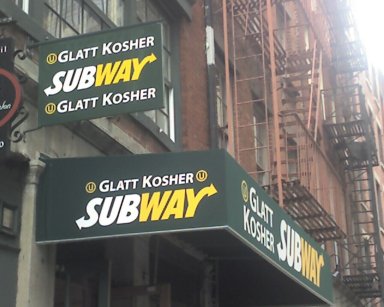
Downtown Kosher Subway Review

UPDATE: It has come to my attention that the kosher Subway reviewed in this post is no longer. Read on for what was and could be, but making a special trip would be unwarranted.
Those of you up on the latest in Kosher food scene probably heard about the new kosher Subway in the financial district on 28 Water Street. While this is not the first kosher Subway – there are locations in Brooklyn, Queens, and Livingston NJ – this one just happens to be conviniently across the street from my office. Like many Jews in the area, I thought I’d give it a shot on its first day as part of the tribe.


Rambam’s Yehareg V’Al Ya’avor In Pseudocode

Last night in my weekly Rambam havruta, we started chapter 5 of Yesodei Hatorah. Rambam begins the chapter by discussing the obligation to sanctify God’s name (kiddush hashem) and its corollary prohibition against desecrating God’s name (hillul hashem). In providing examples, Rambam segues into the laws of yehareg v’al ya’avor – the conditions under which someone should allow himself to be killed rather than violate a commandment under duress.

But while the laws in Rambam are usually straightforward, the laws of yehareg v’al ya’avor have several qualifiers and criteria to evaluate, to the point that it became difficult to keep track of all of them in proper sequence. Being the computer geek that I am, I figured that pseudocode could come in handy. The following snippet assumes the functions do(); which entails preforming the sin in question and die(); means to allow oneself to be killed. It’s not necessarily the most efficient code mind you, but I’m going for maintainability.1

big3[] = {murder, idolatry, illicitSexualRelations};
if (governmentDecree == true){
    die();
}
else {
    if (big3[].contains(sin)){
        die();
    }
    else{
        if (nonJewBenefits == true){
            do();
        }
        else if (numJews < 10){             do();         }         else {             die();         }     } }


There, that should make everything perfectly clear.
Update: Seth Berger contributes the following optimized code:

if( (!governmentDecree || !big3[].contains(sin)) && ( nonJewBenefits || numJews < 10)) {     do(); } else {die();}

Update 2: Reuven Weiser corrects Seth's optimization since in Seth's code a non-big 3 sin could still result in do(); if a non Jew benefits. This is incorrect and should rather be:
if( (!governmentDecree && !big3[].contains(sin)) && ( nonJewBenefits || numJews < 10)) {     do(); } else {die();}
This sort of confusion often comes up with too much negative logic. We can flip things around to create a slightly more readable optimization:

if ( (governmentDecree || big3[].contains(sin)) || (!nonJewBenefits && numJews >10)){
    die();
else {do();}


1. For Brisker’s, of course


The Abraham Heschels Of Today

And it is not the teaching which is the essential, but the action (M. Avot 1:16)

Note:Parts of this post have been corrected.since publication.

In belatedly commemorating Rabbi Abraham Joshua Heschel’s 100’s birthday, the Center for Jewish History bemoans the absence of a contemporary equivalent, asking “Where are the Abraham Heschel’s of today?” For many liberally inclined Jews, Heschel was the Gadol Hador – a prolific, erudite, knowledgeable scholar who synthesized traditional texts, academia, with contemporary sensibilities and ethics of activism. The problem, apparently, is that no one – or at least not enough people – has sufficiently assumed Heschel’s mantle.


Orthodox Paradox: A Debate on Jewish Values

The big Jewish story of Summer 2007 was Professor Noah Feldman’s now infamous New York Times Magazine article “Orthodox Paradox” (July 22, 2007) in which Feldman critiques Modern Orthodoxy as being inherently and irrevocably inconsistent. The specific “paradox” to which Feldman points is that on one hand Modern Orthodoxy claims to embrace the secular world, yet simultaneously maintains a religious prejudice against it. Feldman cites examples of Jewish particularism in the Talmudic law that Jews do not desecrate the Shabbat to save the life of a non-Jew and through the personal ignominy he faced at his high school reunion having been ostracized due to his intermarriage.

Feldman’s article generated some of the most vociferous discussion among the Jewish intelligentsia and throughout the J-Blogosphere, with Feldman being vilified for betraying the Jewish people either for intermarrying or through voicing his critiques in a public forum.1 While the frenzy has died down since the summer, Feldman exposed a nerve in the Jewish community which still rightfully still agitates many. To address some of those issues and the subsequent reaction, on Thursday October 18th NYU hosted a symposium entitled, “Orthodox Paradox: A Debate on Jewish Values” featuring the eclectic trio of Rabbi Shmuley Boteach, philanthropist Michael Steinhart, and the aforementioned Professor Noah Feldman.

Despite the event’s classification as a “debate”, there was little collective coherency among the three panelists. Instead of addressing one area of “Jewish values” each panelist discussed his own approach to the question based on his own individual set of values.


Franchising Judaism: The Politics Of Exclusion

A good name is better than oil (Kohelet 7:1)

One of the most important business commodities, intellectual or material, is the brand name. More than just a logo, a brand name is the symbolic representation of the entire company, implicitly defining the quality and integrity of its products. Building widespread brand name recognition can take several years, let alone correcting a negative impression, but acquiring an established reputable brand name quickly improves a company’s legitimacy in the eyes of the public. For instance, Rupert Murdoch’s purchasing of the Wall Street Journal gives his new business channel instant credibility (at least in theory).

On a smaller scale, brands can be leased to individuals in the form of franchising. In this system, a small business can leverage an existing brand name and benefit from it’s reputation and advertising. However, the corporate office usually dictates uniform policies from products, pricing, and interior design in order to protect its brand and ensure a consistent experience for the consumer.

Religion follows a similar pattern in terms of connecting name recognition to external expectations. We expect Orthodox Jews to keep kosher, observe Shabbat, and follow the laws and ethics defined by Jewish law. The difference is that Orthodox Judaism has no authoritative “home office” to enforce uniform regulations. As such, the religious “franchisees” are left to argue over who has the most authentic characteristics, and in turn discredit and delegitimize their competitors.

Let’s look at three recent examples from the world of Jewish news:



Second Hand Thoughts on YU’s Medical Ethics Conference On Fertility

I was registered and supposed to attend YU’s medical ethics conference on Fertility, Modern Medicine, and Jewish Law this past Sunday but instead paid a shiva call to R. Moshe Tendler, my teacher of two and a half years, and pioneer in the field of Jewish medical ethics. Thankfully, CuriousJew has her typically thorough writeup of the event.
Some quick-hit second-hand thoughts and observations:

  • If you ever have the opportunity to hear R. Johnathan Sacks, do so. An exemplar of the “integration” model of Torah U’Madda if there ever was one (and a captivating speaker no less).
  • Regarding various fertilization methods, I must cite the classic R. Tendler quote: “You cannot commit adultery with a hypodermic syringe.”
  • One of the “misconceptions” of infertility attributed to Dr. Richard Grazi is that a pelvic exam creates a niddah. I do not have access to the sources presently, but my father agrees saying that it’s really a dispute between R. Yohanan (lenient) and Reish Lakish (strict) in which case we usually follow the teacher. However, he does point out that in a YU shiur he attended, the Rabbi paskened l’humra, apparently buying into the “misconception.”
  • There was some discussion related to multiple births and viability. This discussion is predicated on the Jewish perception of abortion, a topic into which I will not get. However, I do recall R. Tendler discussing the McCaughey septuplets and praising the family for adhering to their beliefs by not aborting any fetuses.
  • The halakhot of shichvat zera levatala are more complicated than simply assur. The Conservative Teshuva on Homosexuality covered many of the nuances despite ultimately punting on the pesak.

Not having been there or having a better command of the subjects, I can’t comment further. Hopefully I will not have such a reason to miss it next year.


Baruch Dayan Emet – Rebbetzin Sifra Tendler

I just received this unfortunate e-mail:

Dear All:
Barukh Dayan Ha-Emet. I am sorry to note the passing of Rebbetzin Sifra Tendler, wife of Rabbi Dr. Moshe D. Tendler, shlita, (rosh yeshiva at RIETS) and daughter of Rav Moshe Feinstein zt”l.
The funeral will take place today at three PM at Rabbi Tendler’s shul in Monsey.
3 PM Community Synagogue of Monsey
89 West Maple Avenue
Monsey, NY 10952
Shiva will be observed at the Tendler residence
4 Cloverdale Lane
Monsey, NY 10952
HaMakom yenachem et’chem b’toch shar avay’lay Tzion vee’Yerushalayim.

Rebbitzen Tendler had been ill for some time, most recently with a relapse of cancer (I believe lymphoma). Our wishes and condolences are with the entire Tendler family.