(כי לא מחשבותי מחשבותיכם ולא דרכיכם דרכי (ישעיהו נה:ח

YUTOPIA

The Online Home of Rabbi Josh Yuter

Browsing Posts in Politics

Yesterday morning I was one of 1,000 Rabbis listening in on a conference call with President Obama on the hot button issue of heath care reform. The call was organized by coalition of Conservative, Reform, and Reconstructionist organizatoins including
The Central Conference of American Rabbis, Union for Reform Judaism, Rabbinical Assembly, Reconstructionist Rabbinical Association, and coordinated by the Religious Action Center of Reform Judaism.
Technically speaking I'm not sure I'm "supposed" to write about the call. The intent of the call was less informative on Obama's position, but more for the Rabbis to explore how to address the health care controversy in their upcoming High Holiday sermons. (In a nice move by Obama's handler's he began his health care discussion by referencing unetaneh tokef). Nevertheless there were point which I took away from the call that I feel are worth sharing with the public at large.

continue reading...

Share

Every week I write a brief "Rabbi's Corner" for my synagogue's weekly e-mail. With the 4th of July this weekend I decided to examine the ideas of and meaning of "Freedom" and "Patriotism". After a little searching I found a fascinating irony - these two terms holy contested in our perniciously partisan society both have linguistic histories conveying ideas of love and brotherhood.
First, according to the Online Etymological Dictionary the origins of word "Free" are rooted in a context of "love":

O.E. freo "free, exempt from, not in bondage," also "noble, joyful," from P.Gmc. *frijaz (cf. M.H.G. vri, Ger. frei, Du. vrij, Goth. freis "free"), from PIE *prijos "dear, beloved" (cf. Skt. priyah "own, dear, beloved," priyate "loves;" O.C.S. prijati "to help," prijatelji "friend;" Welsh rhydd "free"). The adv. is from O.E. freon, freogan "to free, love." The primary sense seems to have been "beloved, friend, to love;" which in some languages (notably Gmc. and Celtic) developed also a sense of "free," perhaps from the terms "beloved" or "friend" being applied to the free members of one's clan (as opposed to slaves, cf. L. liberi, meaning both "free" and "children"). Cf. Goth. frijon "to love;" O.E. freod "affection, friendship," friga "love," fri?u "peace;" O.N. fri?r, Ger. Friede "peace;" O.E. freo "wife;" O.N. Frigg "wife of Odin," lit. "beloved" or "loving;" M.L.G. vrien "to take to wife, Du. vrijen, Ger. freien "to woo."

The term "Patriot" finds its origins in the word patriote or "fellow countrymen", though in political terms it evolved into somewhat of an insult:

Meaning "loyal and disinterested supporter of one's country" is attested from 1605, but became an ironic term of ridicule or abuse from mid-18c. in England, so that Johnson, who at first defined it as "one whose ruling passion is the love of his country," in his fourth edition added, "It is sometimes used for a factious disturber of the government."
"The name of patriot had become [c.1744] a by-word of derision. Horace Walpole scarcely exaggerated when he said that ... the most popular declaration which a candidate could make on the hustings was that he had never been and never would be a patriot." [Macaulay, "Horace Walpole," 1833]

But the term Patriotism was not always an insult, nor was always used as a political sledgehammer to sell flag pins. According to Harvey Chisick's Historical Dictionary of the Enlightenment, "patriotism" could be defined as something akin social egalitarianism and justice:

Unlike the situation in the 19th century, when nationalism tended to be exclusive and confrontational, during the 18th century patriotism belonged with such inclusive and cohesive values as humanity and beneficence. In the course of the second half of the 18th century, a person who provided relief for the poor, or objected to excessively harsh penal laws, or who criticized institutions such as serfdom or slavery, was likely to be described as a good patriot." (p. 314) [emphasis original]

My hope for this 4th of July our nation can look back to the history of these important words not be lost amongst the ever-spiteful partisan rhetoric which continues to divide our country. I hope that we can spread freedom - in all senses - to our fellow citizens of the world and that we remember the message of what it once meant to be a true patriot.
While I'm not optimistic, I am proud to live in a country where I have the freedom to dream.

Share

I've been getting some requests to respond to some comments made by my teacher, R. Moshe Tendler as reported in today's NYPost. For this latest YU controversy, the Post reports that one of YU's faculty members recently underwent a sex-change operation:

continue reading...

Share

30 Is The New 50

2 comments

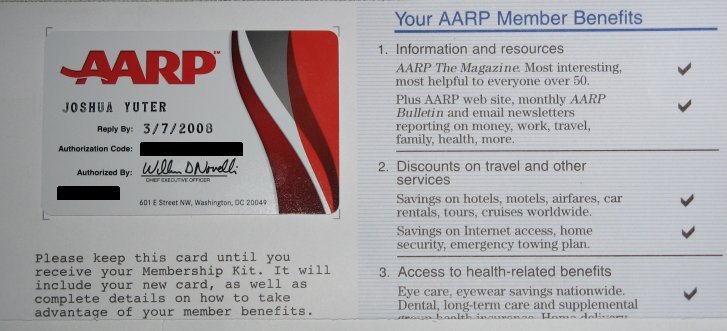
Since turning 30 last August I've been a little more aware of my age, making the occasional self-deprecating grizzled remarks about the old days. Age is especially noticeable in the increasingly youthful Washington Heights community where the shul is even running a single's event specifically for people ages 22-29.
All this I can deal with, but then I get the following in the mail:
AARP Membership
On the plus side I guess this means I can cash out on social security earlier and join one of the most powerful lobbying groups in the country.
Now get off my lawn.
*waves stick*

Share

Discrediting Subprime “Victims”

1 comment

We recently mocked big business for outsmarting themselves in the subprime crisis, but it seems that there's plenty of criticism to go around. Take for example, this powerful New York Times article of the subprime crisis' impact on communities. To be sure, people are living scared and are understandably nervous about losing their homes and even treading financial water. And we can even grant that lenders have and still do engage in predatory lending practices, including student loans.
But just as we must hold big businesses accountable for their unethical practices, we must also examine the motivations of the affected individuals involved as well. Specifically, while big businesses are motivated by profit, many "victims" sought to maximize consumption with minimum immediate and therefore minimum visible cost. For example, the article reports that one person facing foreclosure, "bought her Bronx home for $535,000 with no cash down." For many people, myself included, $535,000 is a great deal of money. To "purchase" a house for that amount entirely on credit demonstrates not just a lack of financial acumen, but the immature mentality of expectation and entitlement i.e. that desires ought to be satisfied immediately.
Worse is that people aren't even learning from their mistakes. The article continues:

In some cases they cannot even work up the money to furnish their homes. Few customers have visited Boston Road Furniture, despite a handwritten come-on taped to the window that promises anyone can ?Get Up to $3,000 Instantly No Job No Credit Check.?

The proprietor adds:

?We need a government loan,? he said. ?This country is falling apart. We need customers. We need some help. So many ?For Sale? signs in this neighborhood. People just have to leave their homes and run.? [emphasis added]

The communal mentality is firmly entrenched in credit as a normal way of operation. True credit and financial liquidity are an essential part of economic systems, but here we have the epitome of short term financial thinking. Immediate interests are always satisfied, while the inevitable costs are simply ignored and disregarded - out of sight, out of mind.
Big businesses did take a hit for their own corporate greed to the tune of several billion dollars, and deservedly so. But while there are no doubt actual victims of the subprime crisis, there are also affected individuals who are now facing the consequences of their own materialism.
I refer all others to SNL'a helpful advice.

Share

JPMC’s Fred Thomson Town Hall

This campaign season JP Morgan Chase has been holding Town Halls featuring various presidential candidates. Apparently one of CEO Jamie Dimon's mandates was that the company become more involved politically in terms financial support or interest. Thus far the company has not only supported multiple candidates, but has assigned senior people as liaisons to various campaigns. (One would assume such support dwindles once front runners are more established). Furthermore, by holding Town Halls, we give the impression that JP Morgan Chase does not only financially support candidates, but its employees are politically interested.
The implications should be obvious that a multi-billion dollar company is attempting to gain influence in politics, no doubt to advance its own financial benefit. In fact JP Morgan Chase has its own PAC responsible for among other things donations (PDF).1 On the candidate's side, they get more money and exposure. From the employees perspective, we get to bask in the glory of a presidential hopeful and get away from our desks for a bit.
But as the emcee pointed out, the main problem with running these events is that the candidates have more important things to be doing - like trying to get elected. As the campaign continues, the only people who will be available will be the ones who have already lost or have nothing left for which to run. A few months ago, JPMC scored Hillary Clinton - and event which I was unable to attend. This brings us to today's event featuring Senator Fred Thompson, which didn't quite fill the 200 seat auditorium.
Unfortunately the entire program was roughly 30 minutes. Sen. Thompson spoke for about 15 minutes followed by 3 audience questions. Given the time constraints I cannot blame Sen. Thompson for not going too in depth on any particular issue. My quick impression was that he seemed subdued, down-to-earth, and very straightforward. He outlined the main principles of his platform which sounded typically Republican (free markets, free trade, strong military, lower corporate and personal taxes). Of particular interest was his policy on social security reform which would tie benefits to inflation as opposed to wages.
Given more time, I would have liked to hear his response to William Voegeli's pragmatic assessment of Republican policies but considering the current polls that might not be an issue.
I will say that from a personality perspective, Sen. Thomson came across as a "straight-shooter." He calmly presented what he feels are the most important concerns of the country and what he would do differently. Perhaps it was the lack of mainstream media and celebrity, but I found the tone refreshing.
There were some requests for other candidates including Rudy Giuliani and Barack Obama, which I doubt would leave open seats. I'll post if anything interesting come up in the future.

1. I A quick survey of the PDF shows n 2006, JP Morgan's PAC made 820 donations nationally totaling $1,342,909.78. It seems that on a national level JPMC tries to hedge between Democrats and Republicans. Certain imbalances are due to JPMC reporting donations made by companies which were later taken over by JPMC. The largest individual beneficiary I saw was Ways and Means Chairmen Charles Rangel with a $10,000 donation.

Share

Whither The Jewish Vote?

1 comment

Be careful in your relations with the government; for they draw no man close to themselves except for their own interests. They appear as friends when it is to their advantage, but they do not stand by a man in his time of stress (M. Avot 2:3).

Despite being a demographic minority in America, Jews seemingly wield a disproportionate influence in American politics such that the "Jewish Vote" becomes an annual topic of interest. Politicians are concerned with this minority that both Democrats and Republicans equally compete for the "pro-Israel" label, and any missteps must be swiftly addressed. There has been some recent discussion as to the nature, significance, and future of the Jewish vote specifically mostly focusing on party affiliation and voting patterns. Today on YUTOPIA we will be reconsidering if partisanship is really the ideal context for defining the Jewish vote.

continue reading...

Share

9/11: Five Years Later

1 comment

Like most of the country today, I've been thinking about 9/11. Granted given the current geo-political situation, it's difficult *not* to think about 9/11 since there is always something in the news reminding us. For New Yorkers, the experience is understandably much more personal. It wasn't just your country that was attacked, but your home. The familiar iconic towers vanished, as well as the lives of many friends and loved ones. Personally, despite my extended connection with New York City, I've always had a somewhat detached perspective towards 9/11, mostly because I wasn't around at the time.
I remember being in afternoon seder in Gruss learning hilchot shehita when someone came in with the news he read off the internet. Knowing this person's jocular nature and the implausibility of the report we didn't take him seriously at first. Eventually we went in to double check, and were shocked at the images and video. Our lagging single dial-up connection combined with the worldwide demands on the Internet throttled any incoming information. Phones were down for hours so we couldn't even make direct connections with people. Understandably, confusion was rampant as were the feelings of uncertainty and helplessness.
Still, while we felt these emotions, we weren't impacted directly. We worried and prayed, but our day was still basically uninterrupted; there was even a bris in Gruss the following day. Then of course, the religious hyperbole started coming in. It only took a few days until I started hearing quotes from kabbalists claiming how this would usher in the war of Gog and Magog or other signs of the impending apocalypse. Having not been so directly affected, 9/11 almost immediately became mythic; it wasn't so much a terrorist attack but a watershed event in hummanity.
Returning to New York, I felt like a ghost. There was the aura of tragedy and meaning, a collective experience with which I could never fully empathize. Gradually people moved on, but as those who pass Ground Zero today will notice, the holes are still there.
I think it's obvious that people are still dealing with the tragedy and are in their own stages of grief. Some have accepted and moved on, others are still in denial. For me 9/11 is somewhere in the middle of feeling the raw emotions yet always remaining distant. It is both personal and abstract simultaneously. But while there is a feeling that I will never be able to share with my fellow New Yorkers, I hope that I will never have the opportunity to share such an experience in the future.

Share

One More Jewish Mayor

1 comment

SIW is reporting on Orthodox mayors and not surprisingly, good 'ol Springfield, NJ gets overlooked once again. Not only have we had an Orthodox mayor in Clara Harelik, but a female Orthodox mayor who has served several terms1 and recently won the Mayor of the Year award for Union County.
Who knew Springfield could be so progressive?

1. For some wacky reasoning you don't vote for mayors directly in Springfield, but for a five-member Township Committee who selects the mayor from among themselves.

Share

Two-Way Tolerance

1 comment

It's not surprising that as we approach the GLBT World Pride in Jerusalem (August 6-12), we find increasingly critical and hostile rhetoric against the event. Jerusalem is no stranger to religious controversies, and the opposition to homosexuality is nearly universal among the major religions.
My understanding is that there are two major goals of the Pride events. The first is to provide support and encouragement for the GLBT community internally, and the second is to promote tolerance and acceptance. (Yes, I know this is an oversimplification). From the World Pride mission statement:

It is time to demonstrate to our community, to our neighbors and peers and indeed to the world, not only that we belong, but that our love and our pride can cross the harshest borders that divide people.

However, with the peaceful calls for love, pride, and belonging is an understated antagonism towards those religions which reject the GLBT community. There is no coincidence that the first World Pride event in 2000 took place in Rome with the intent to take their message "to the Pope's doorstep." Given all the locations worldwide where the native culture is more hospitable to the GLBT community, the initial choice of Rome and subsequent selection of Jerusalem is just as much a statement as the event itself. As the mission statement proclaims,

"In these times of intolerance and suspicion, from the home of three of the world's great religions, we will proclaim that love knows no borders." [emphasis added]

World Pride is not simply a matter of communal bonding or promoting tolerance, but a subliminal protest against intolerant religions. There is of course an intelligent strategy at work here. By assuming a greater challenge, the GLBT community can more effectively galvanize itself by breaking another barrier (if peaceful) or standing strong in the face of opposition.
But consider some of the stated themes of the upcoming World Pride:

  • Our values are guided by tolerance, equality and pluralism.
  • The parade in Jerusalem is conformed to the city's nature in respect toward the local orthodox populations.
  • The pride events bring a new inner-faith message of equality and tolerance.
  • Obeying the law and avoiding violence and harsh criticism are some of our messages.

Given the underlying attitude towards religion, these statements are disingenuous at best. If the values are guided by tolerance, then a better location should have been selected. The parade obviously does not conform in respect to the Orthodox populations as evidenced by the vehement opposition. And if the theme is truly to avoid harsh criticism (unclear if it refers to giving or receiving) then why select such a volatile location?

My issue here is not questioning the right to assemble or even the right to protest GLBT's treatment in the major religions. But I personally find it hypocritical to do so under the banner of tolerance. The choices of Rome and Jerusalem seems to be an "in your face" approach almost daring people to pick a fight. If the message is really about tolerance, then this strategy is counter-productive since the parade will most likely breed even more resentment.

I do think there can be a compromise between religion and the GLBT community, and I offered my own suggestions to that effect. But as I argued regarding pluralism, tolerance does not mean that other people must unilaterally accept you on your terms. There first has to be mutual acknowledgement and respect of each other's beliefs and perspectives, and this would have to entail avoiding obviously antagonistic actions.

If one requests tolerance, one must be willing to give it as well.

Share
Powered by WordPress Web Design by SRS Solutions © 2012 YUTOPIA Design by SRS Solutions